Monograph
2021
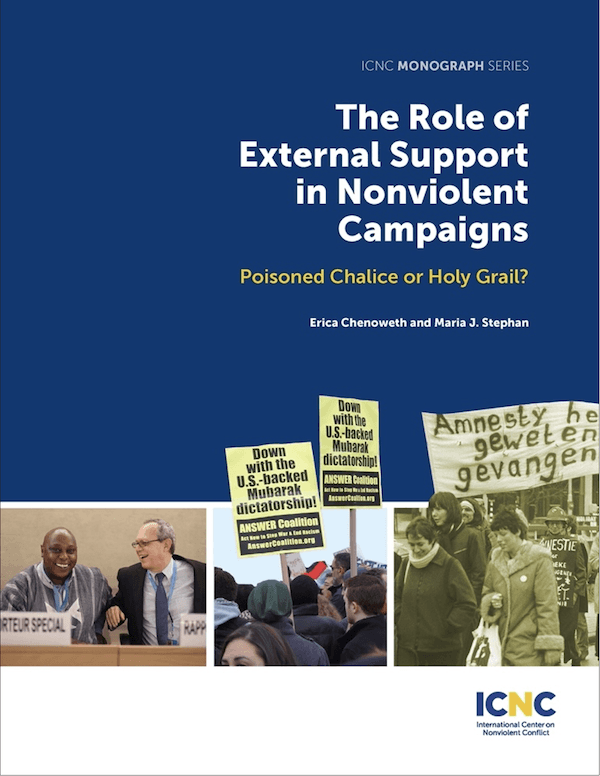
The Role of External Support in Nonviolent Campaigns
Poisoned Chalice or Holy Grail?
By Erica Chenoweth, Maria J. Stephan
Get the paperback
Available wherever books are sold. Any profit goes back into new research and writing workshops.
Buy the paperback
Download the free PDF
About the book
This monograph is based on an ICNC-sponsored multi-year research project that examines the effects of different forms of external aid on the outcomes and longer-term impacts of civil resistance campaigns. Very little research has systematically investigated the impacts of external support on the effectiveness of nonviolent resistance. Existing research reaches somewhat contradictory conclusions, with some finding that external support for nonviolent campaigns is harmful, that external support is sometimes helpful, or that external support has little observable effect. This study assesses different types of external assistance—material and non-material—to civil resistance movements offered by state and non-state actors at different stages: pre-, during and post-conflict periods. It further evaluates the impact of the specific type of aid, its timing and provisions by different actors on the overall trajectories of civil resistance campaigns and their outcomes.
Topics
Movement Support
Written for
Scholars
About the authors
Erica Chenoweth
Erica Chenoweth is the Frank Stanton Professor of the First Amendment at Harvard Kennedy School, Faculty Dean at Pforzheimer House at Harvard College, and a Susan S. and Kenneth L. Wallach Professor at Harvard’s Radcliffe Institute. Chenoweth studies political violence and its alternatives. They have authored or edited nine other books and dozens of articles on mass movements, nonviolent resistance, terrorism, political violence, revolutions, and state repression, including Civil Resistance: What Everyone Needs to Know (2021) and On Revolutions (2022).
Chenoweth’s current book project investigates the puzzling decline in the success of civil resistance movements in the past decade, even as the technique has become more popular worldwide. Along with Zoe Marks, Chenoweth is also the author of the forthcoming book that explores how women’s participation impacts mass movements.
At Harvard, Chenoweth directs the Nonviolent Action Lab, an innovation hub that uses social science tools and evidence to support movement-led political transformation. There they maintain the NAVCO Data Project, one of the world’s leading datasets on historical and contemporary mass mobilizations around the globe; the Women in Resistance (WiRe) Dataset, which catalogues the gender composition of such movements (with Zoe Marks); and the Crowd Counting Consortium, a public interest and scholarly project that documents political mobilization in the US (with Jeremy Pressman).
Foreign Policy ranked Chenoweth among the Top 100 Global Thinkers of 2013 for their efforts to promote the empirical study of nonviolent resistance. Chenoweth received the Karl Deutsch Award, which the International Studies Association gives annually to the scholar under 40 who has made the greatest impact on the field of international politics or peace research. Chenoweth’s book Why Civil Resistance Works: The Strategic Logic of Nonviolent Conflict (2011) with Maria J. Stephan won the Grawemeyer Award for Ideas Improving World Order, and the Best Book Award from the American Political Science Association. In 2022, Chenoweth was elected into the American Academy of Arts and Sciences.
Maria J. Stephan
Dr. Maria J. Stephan’s career has bridged the academic, policy, and non-profit sectors, with a focus on the role of civil resistance and nonviolent movements in advancing human rights, democratic freedoms, and sustainable peace in the US and globally. She most recently directed the Program on Nonviolent Action at the U.S. Institute of Peace, overseeing cutting-edge research and programming focused on the nexus of nonviolent action and peacebuilding. Stephan is the co-author (with Erica Chenoweth) of Why Civil Resistance Works: The Strategic Logic of Nonviolent Conflict (Columbia University Press, 2011). She is the co-author of Bolstering Democracy: Lessons Learned and the Path Forward (Atlantic Council, 2018); the co-editor of Is Authoritarianism Staging a Comeback? (Atlantic Council, 2015); and the editor of Civilian Jihad: Nonviolent Struggle, Democratization and Governance in the Middle East (Palgrave, 2009). From 2009-14, Stephan was lead foreign affairs officer in the U.S. State Department, serving in Afghanistan and Turkey. She later co-directed the Future of Authoritarianism initiative at the Atlantic Council. Stephan has taught at Georgetown University and American University. She received her BA from Boston College and her MA and PhD from the Fletcher School of Law and Diplomacy. Stephan, a native Vermonter, is a lifetime member of the Council on Foreign Relations.
Keep reading

Monograph
2024
All Rise
Marcin Mrowicki

Monograph
2023
Prison Hunger Strikes in Palestine
Malaka Mohammed Shwaikh, Rebecca Ruth Gould

Monograph
2022
Resource Mobilization in Palestinian Nonviolent Campaigns
Mahmoud Soliman

Monograph
2021
Civil Resistance Against Climate Change
Robyn Gulliver, Kelly Fielding, Winnifred Louis